Xunyang Hong

From spectra
to electron behaviour.

I use resonant inelastic X-ray scattering (RIXS) and numerical models to investigate how electrons move and interact in superconducting material families.

Two projects: uncovering collective charge motion in LESCO, and comparing magnetic excitations in nickelates and cuprates.

Three useful terms
Charge order
A repeating spatial pattern in electron density.
Phonon
A collective vibration of the crystal lattice.
Magnon
A collective wave of electron spins—their magnetic degrees of freedom.
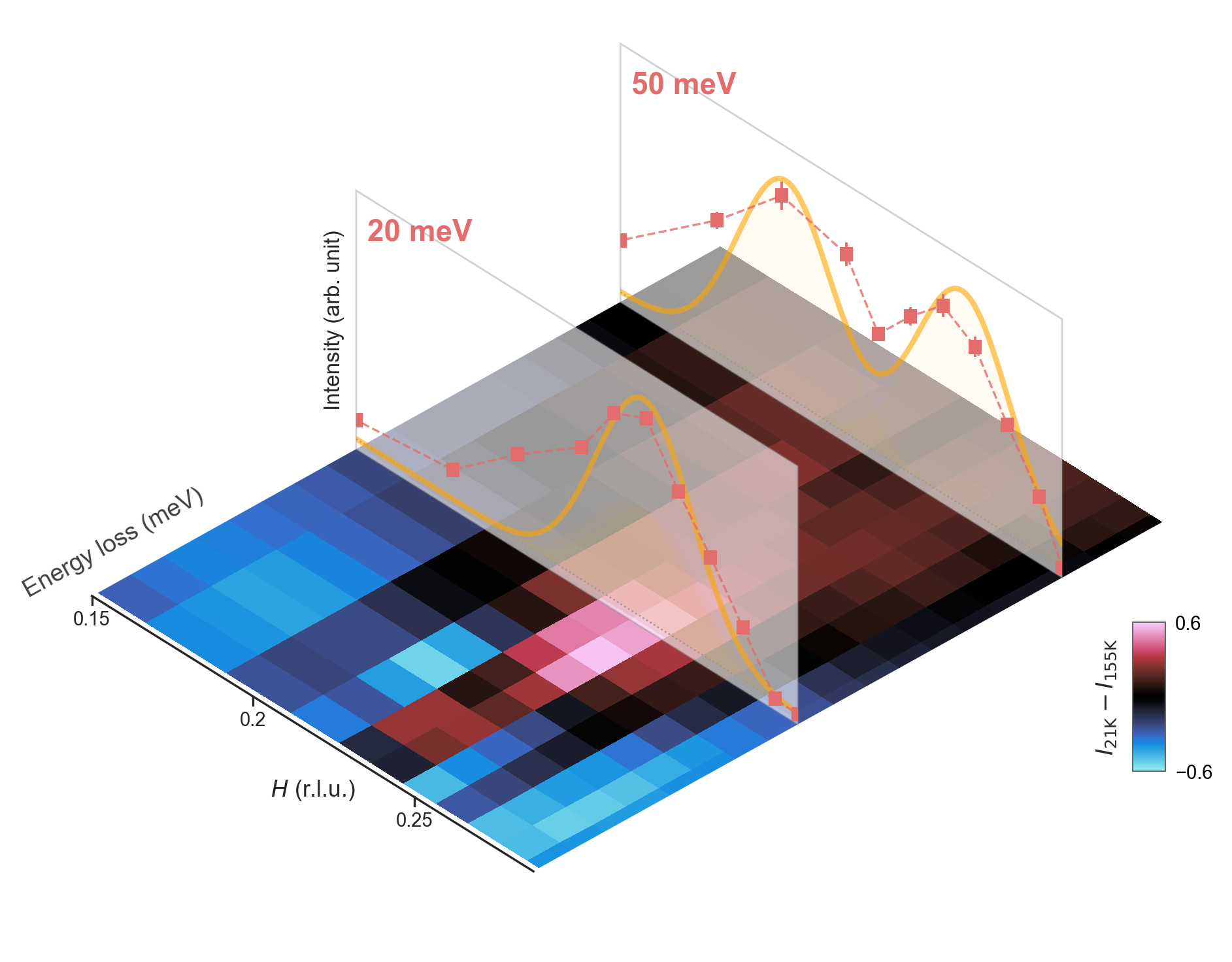
Three-dimensional view of a LESCO temperature-difference intensity map, with momentum cuts at 20 and 50 meV.
LESCO: energy and momentum cuts through a temperature-difference mapOpen figure

Uncovering a hidden charge signal.

In LESCO, a copper-oxide material, electrons form a repeating charge pattern. Can we isolate how that pattern fluctuates in a spectrum crowded with lattice vibrations?

Separate the overlapping components.

Fit the elastic line, low-energy charge contribution, phonon peaks and background using the measured energy resolution. Compare how these components change with momentum and temperature.

The key analysis problem: several physical processes contribute to the same energy window.
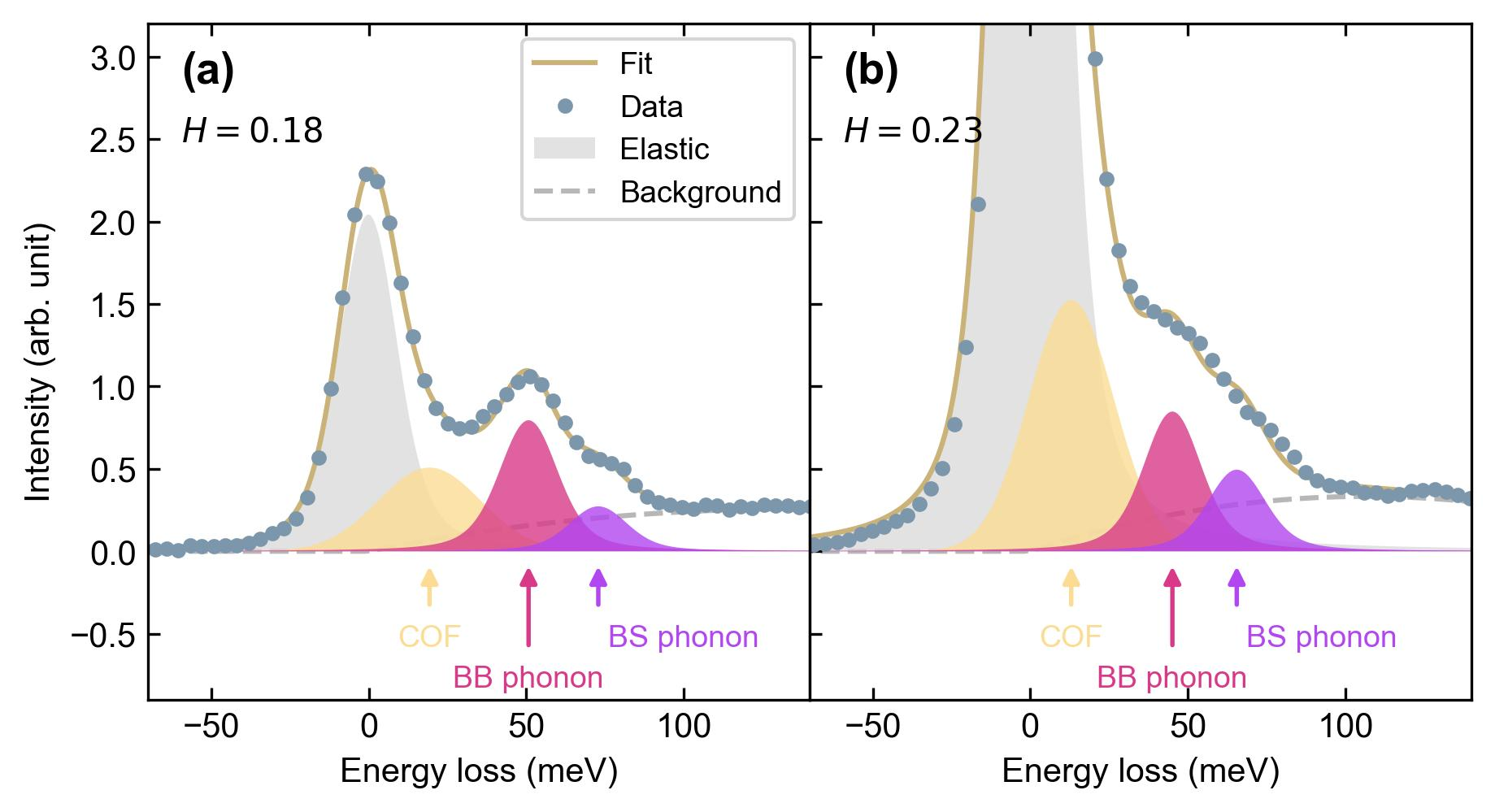
Two measured LESCO spectra with separate fitted elastic, charge-related, phonon and background components.
Measured spectra and their fitted components; the phonon peaks lie near 50 and 70 meV.Open figure

Follow the remaining signal.

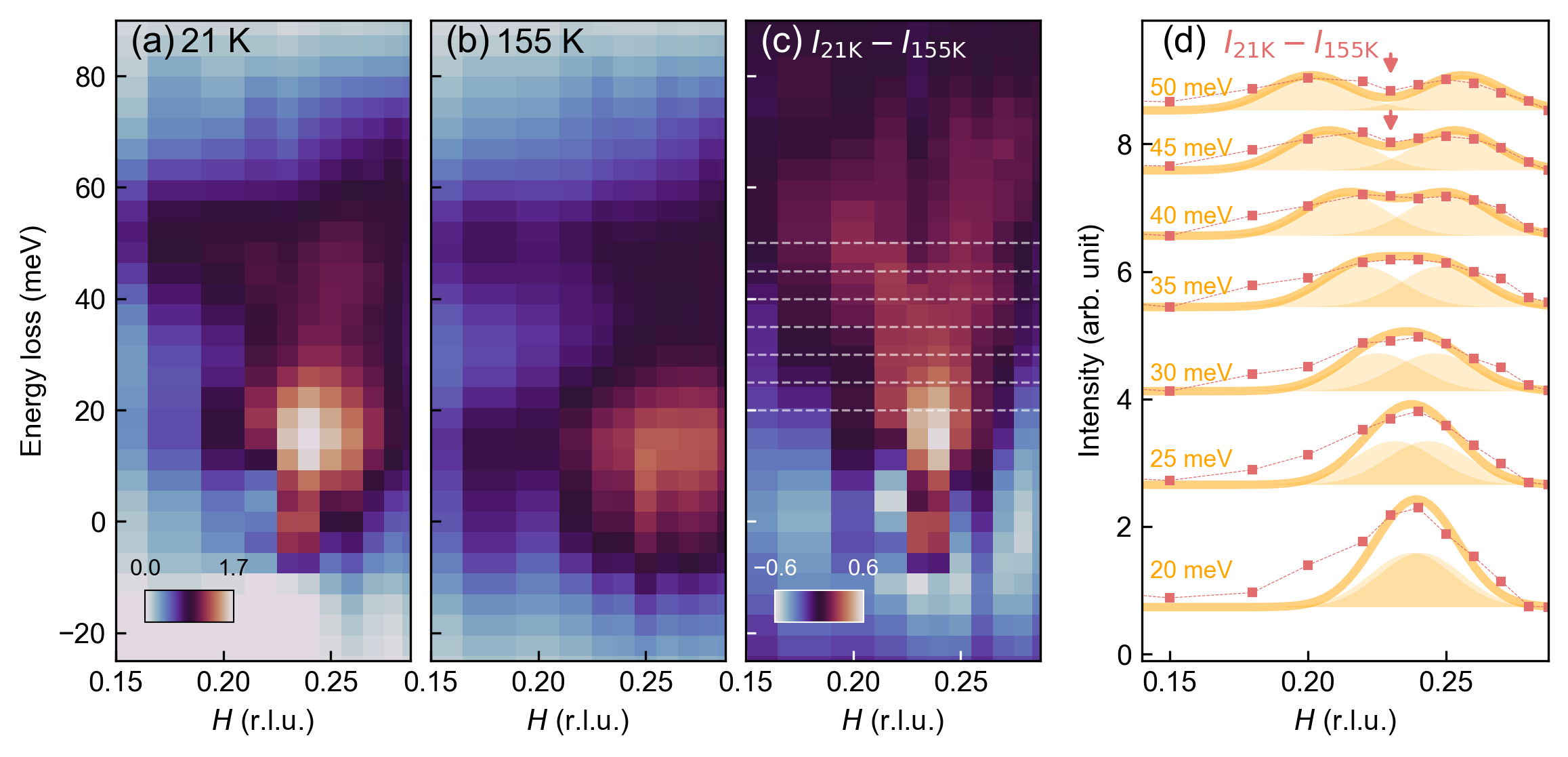
Remove the elastic contribution and compare low- and high-temperature data. This suppresses the nearly temperature-independent phonon signal and reveals a feature whose energy changes with momentum.

The findingEvidence for a dispersive electronic contribution, consistent with collective fluctuations of charge order.

Temperature subtraction provides a separate cross-check on the spectral modelling.

LESCO inelastic intensity at 21 K and 155 K, their difference, and constant-energy momentum cuts showing a splitting feature.
From left: low temperature, high temperature, their difference, and momentum cuts through that difference.Open figure
Unveiling the nature of collective charge excitations in a cuprate superconductor Read the study

Comparing how strongly electrons interact.

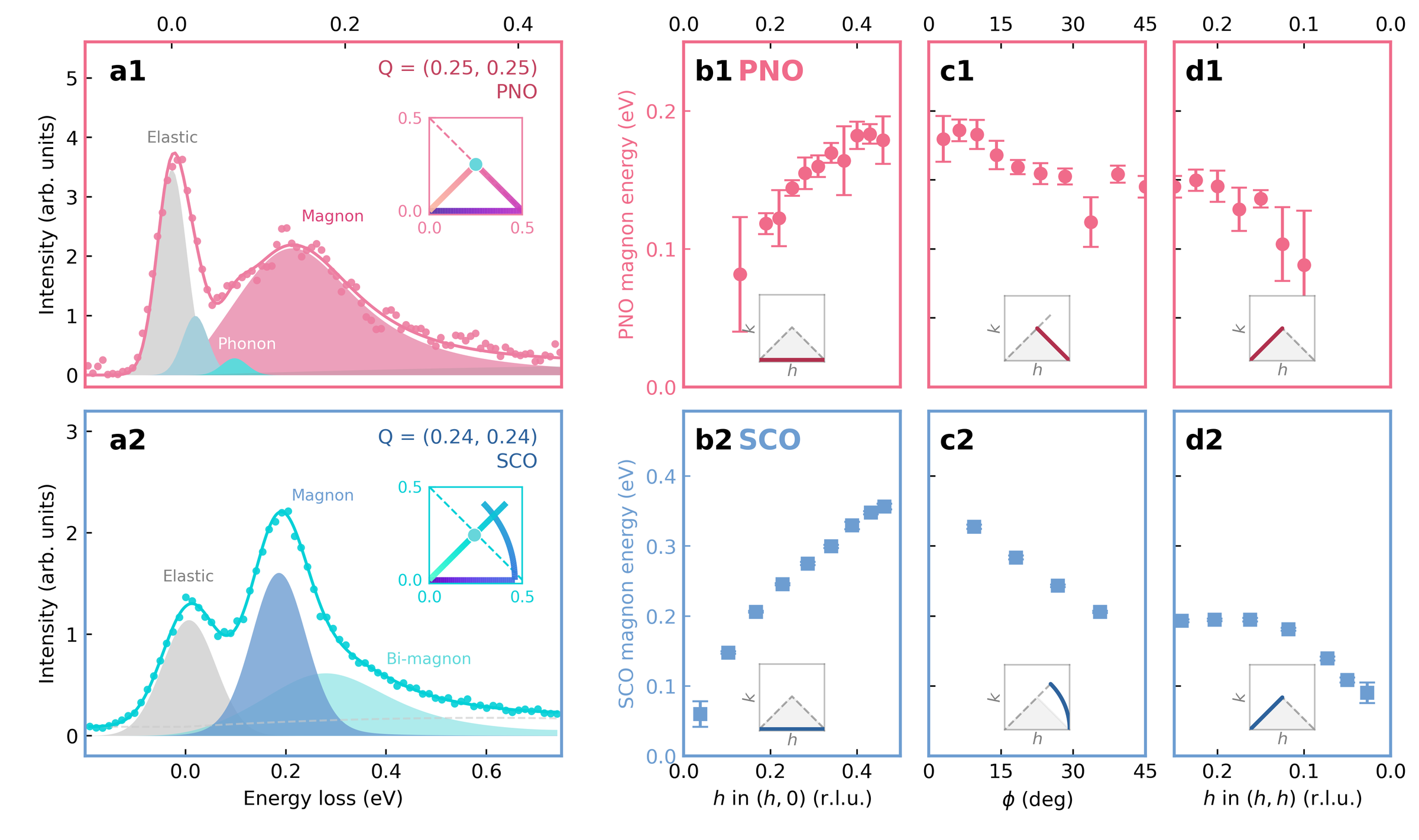
PrNiO2 (PNO) and SrCuO2 (SCO) have similar layered structures but different magnetic spectra. We compare their collective spin waves, or magnons, using the same analysis framework.

Extract the magnetic dispersion.

Model the magnetic peaks together with elastic scattering and other low-energy contributions. Tracking the fitted magnon energies across momentum gives a dispersion: a map of how the excitation propagates.

PNO has a lower magnon energy scale and weaker variation along the magnetic zone boundary than SCO.

Fitted spectra and extracted magnon energies along several momentum paths, with PNO in the top row and SCO in the bottom row.
Top: PNO. Bottom: SCO. Component fits lead to the magnetic dispersions plotted alongside them.Open figure

Connect spin waves to electron motion.

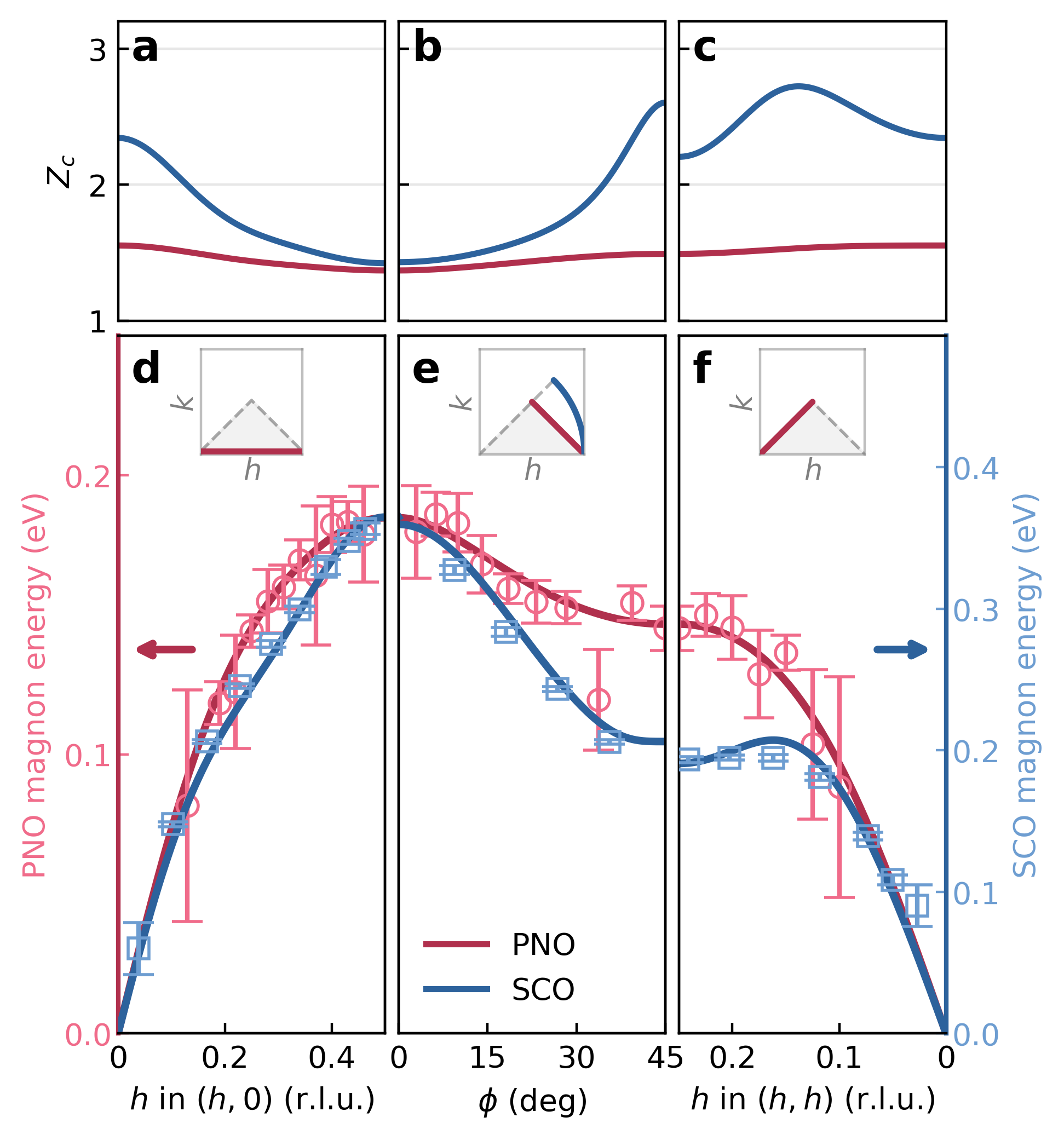
Fit both materials with a Hubbard-derived spin model, including longer-range hopping and quantum corrections. Here U quantifies local electron repulsion and t describes hopping between neighbouring sites.

The findingPNO has the larger interaction-to-hopping ratio, U/t, even though its inferred U is smaller.

These estimates depend on the assumed hopping ratios and the spin-wave approximation.

Model correction factors above measured and fitted magnon dispersions; PNO is red and SCO is blue, with separate energy axes.
Red: PNO. Blue: SCO. The lower panels use different energy scales; the upper panels show the model's correction factor.Open figure
Impact of electron correlations on infinite-layer cuprates and nickelates Read the study