
Preface
This semester (2025 Fall) I was a teaching assistant for the course "Condensed Matter Physics" (PHY401) at the University of Zurich. I was responsible for leading the tutorial sessions and preparing the exercise sheets. I also attended the final oral exam as an examiner.
Students Evaluation
Every semester, the students are asked by the university to fill in a questionnaire about the instructor. By the end of the semester, I received the following feedback from the students:
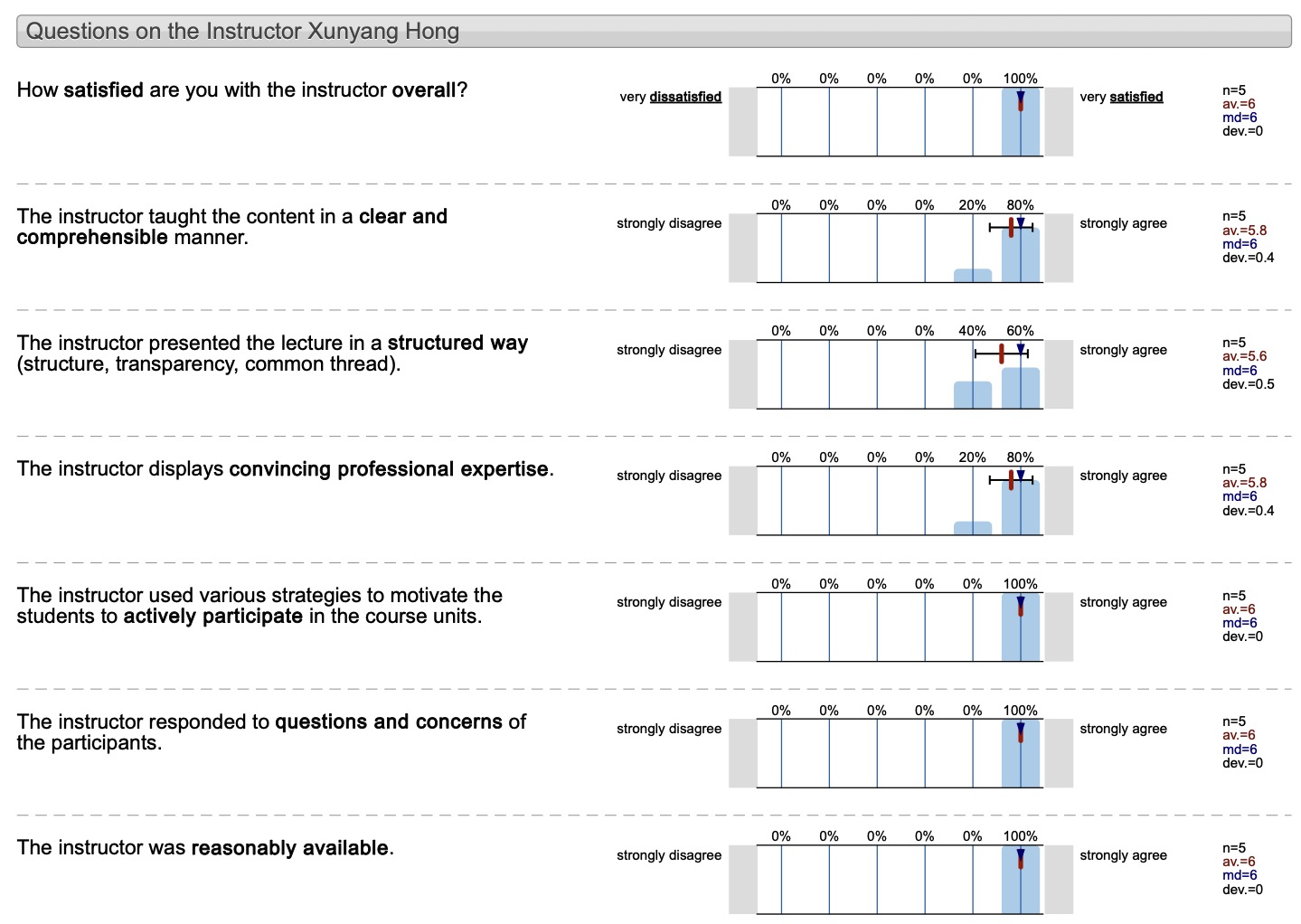
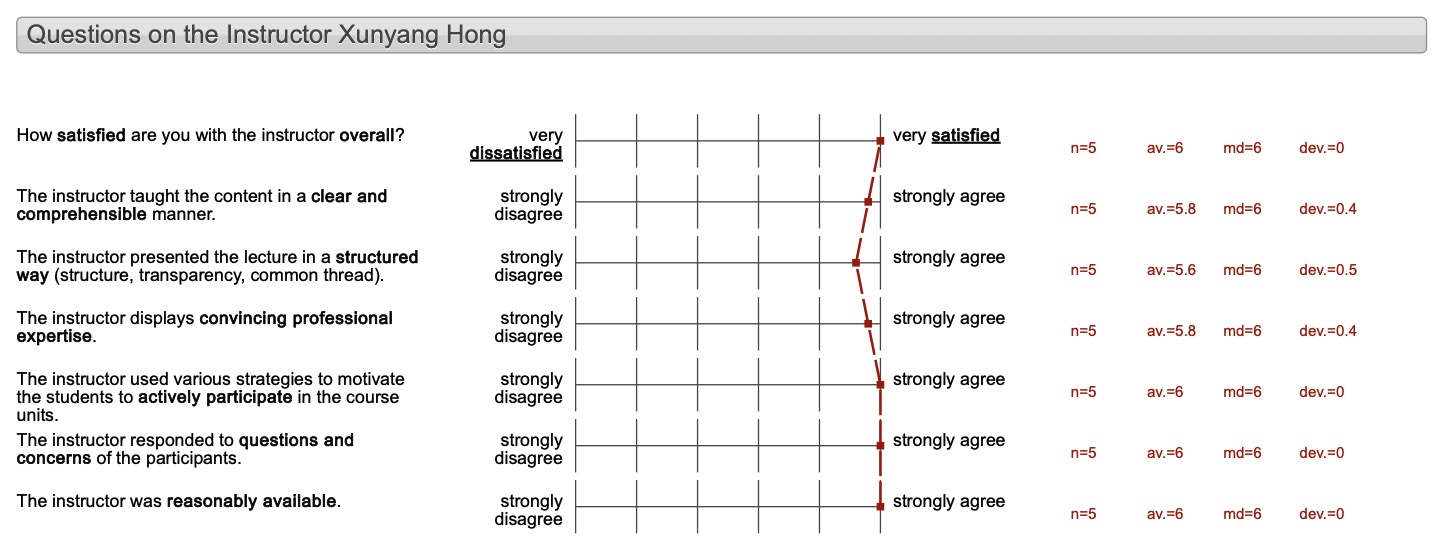
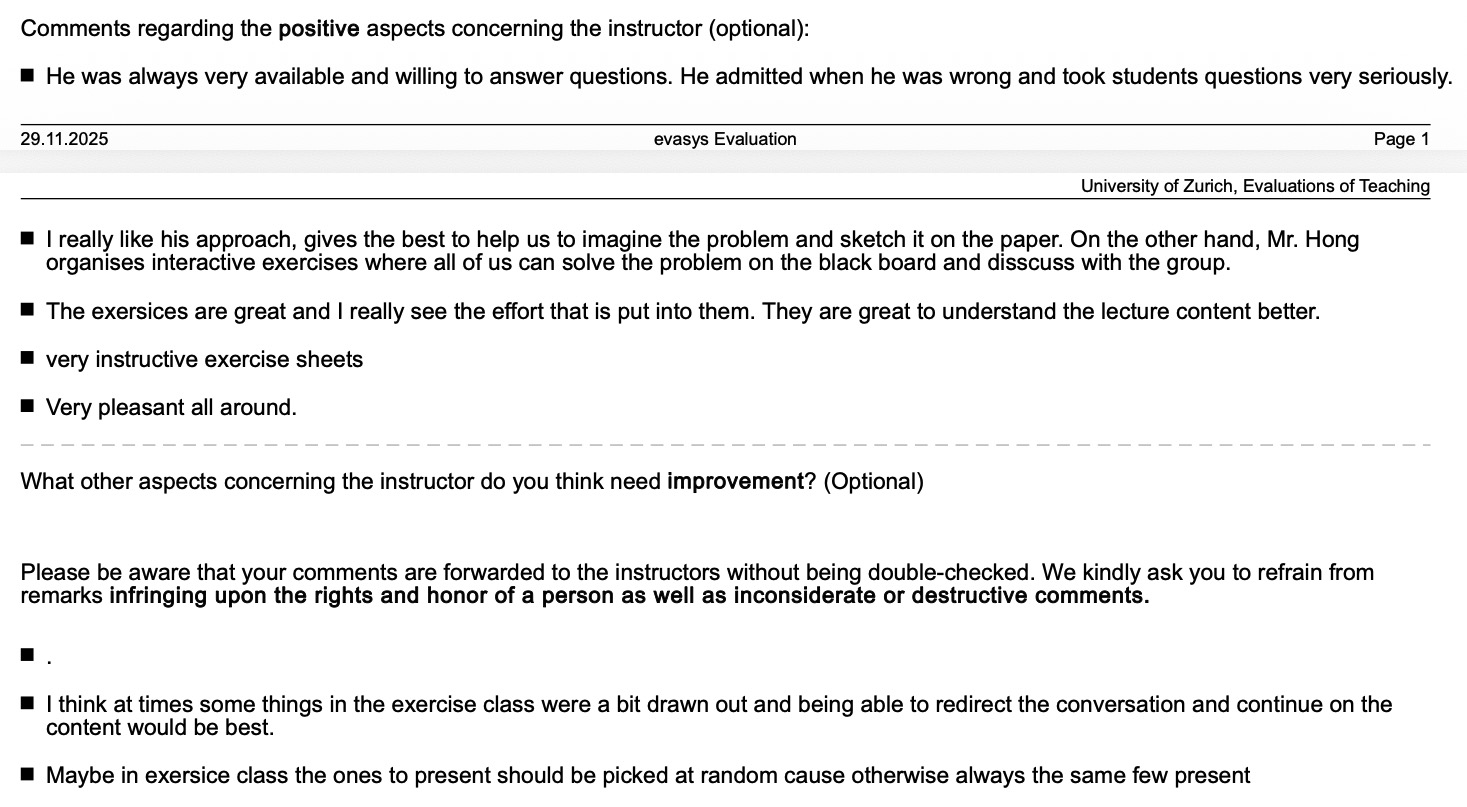
What other aspects concerning the instructor do you think need improvement?
- I think at times some things in the exercise class were a bit drawn out and being able to redirect the conversation and continue on the content would be best.
- Maybe in exersice class the ones to present should be picked at random cause otherwise always the same few present
Other comments
- I could tell he put a lot of time into these questions and honestly they were some of the best composed questions I have had in physics. It felt like they led you through the topic, without giving too much, and still allow us to learn and makes mistakes. Really cannot compliment the way these were written enough.
- The exersices help a lot to understand the content of the lecture
I am quite happy that the students found my exercise sheets helpful and instructive. In fact, I spent most of my time preparing and polishing the exercise sheets. and all those efforts paid off.
At the beginning of the semester, the professor told me that I can simply just take the exercise sheets from last year, which won't take me much time to prepare. However, after going through the exercises pool from last year, I realized the following problems:
- The course this year is not structured in the same way as last year. The order of the topics is different. Therefore, it does not make sense to still take the original exercise sheets, since they were built upon each other. For example, some exercise assumed the students already know the Landau theory, while in this semester the Landau theory actually comes quite late in the course.
- The old exercise sheets do not fully cover the content of the course.
- Some exercises are even wrong. For example, the Bohr-Sommerfeld quantization exercise does not use the canonical momentum, but rather use the mechanical momentum, which is not correct.
- Some exercises are not clear about the setup of the problem, some explanations are too vague or even missing.
Therefore, I decided to make my own exercise sheets that follow the new course structure, and structure the sheet in a more logical and student-friendly way. In the end, I replaced roughly 60-70% percent of the original exercises. You can find my exercise sheets here, together with my ideas and thoughts on each exercise I made.
Reflections on the tutorial sessions
Specifying the role of the teaching assistant
During this semester, I was also taking a course about "how to be a TA" alongside this course. In the first few lectures I got to know that I need to specify the role of a TA at the beginning of the course. This could avoid conflicts and gauge the expectations from both the students and the TAs themselves.
This is what I did:
Opening Speech in the Tutorial Session — "As a TA, I will be responsible for..."
As a TA, I will be responsible for making the exercises, leading the exercise session, making friends with you guys :D I hope to share my knowledge with you and hear your thoughts about how you feel about the content covered in the lecture, how difficult it is, and how the course goes in general. I would also like to know more about the background knowledge you already have, so that I will have more idea of how to go about framing up the exercises.
My goal is to give you such exercises that (1) help you bridge the gap between your knowledge and the content covered in the lecture; (2) Deeper insight in the theory without too much derivation; (3) More confidence in solving physics problems.
Please feel free to let me know how much time you spend on the exercise last week. Ideally it should be more than 2 hours but preferably less than 5 hours. I don't want you guys spend too much time just on this course. Also I will try to make the it more of a "prove this" kinda exercise so that you won't get stuck in one small sub-question even if you can't solve that. This is important cuz I am well aware of how demotivating it could be when you are struggling with one small question for 2 hours. So please just skip it if you can't solve it within like 1 hour. it won't affect your next step since you already know the "results", you just probably don't know how to prove it.
Just to let you know, I am also not a big expert in this field. There are a whole bunch of things I don't understand in this course. I have learned it once, but nothing more than that. There might be some problems coming out that I don't understand. In that case, we could discuss together and hope to spark some new thoughts and ideas along your journey through this course.
Finding a way to get the students more involved
In Tutorial session description I explained how the tutorial class was organized. Basically students are invited to come to the blackboard to present their solution, rather than the TA does the part. This is inspired by the Feynman Technique. The TA is more responsible for guiding the solution.
The problem I had in the tutorials is that: many of the times when the students presented their solution, they did it in a basic and plain way, which might be a bit boring for the other students. If the tutorials keep going like this, all students will probably fall asleep.
The way I solve this is to provide my own insights and thoughts on the problem, in between the two students' solutions presentation. In a word: it goes like student pre -> my comments and insights -> student pre... It might sounds a bit tricky at first sight, but it was actually not too hard to do: I prepared the exercise sheets, and naturally I have a lot in my head that is too much to put in a single exercise sheet. There is a lot between the lines and I can use them as the material for the tutorials.
An example: in exercise sheet 10, the students are asked to perform a loop integral on both sides of the Eq. (10). A pitfall in this is that the loop integral seems to be zero but it is not, but why. The students might not see why. Therefore, I provided my explanation on this after the student presenting their solution. (see Exercise Sheet 10). The idea is that the phase function is not a single-valued function, therefore simple vector calculus theorems cannot be applied.
Another way to make the tutorials more engaging is to throw some questions to the students and let them think actively during the tutorials. An example is the gauge problem in exercise sheet 9. See Exercise Sheet 9.
Communication with the professors
One thing I noticed that I didn't do well is the communication with the professors. I already started to make my own exercise sheets, without asking them for permission in the first place. Although when I told them about it, they were fine with it. But things could go wrong if they weren't. Therefore I also learned a lesson from this: I need to be more proactive in communicating with the professors.
Handling students' questions
I got a comment from the students' evaluation: "I think at times some things in the exercise class were a bit drawn out and being able to redirect the conversation and continue on the content would be best." If I understand correctly, this is comment about me being asked a question that I can't quite handle properly. As I stated before, I would envision a TA being someone between the professor and the students, not having to know everything in physics. Therefore, it is totally okay if a TA cannot answer a hard question.
Sometimes when I can't handle a question, I tried to take some time to think and ask the crowd to discuss the question together. However, the downside of it is that it slows down the tutorials session. I need to find out a better way to handle this situation.
I have also tried saying something like "I can't answer it for now, but I can try to figure it out afterwards and get back to you." And I actually did that for the "gauge mystery" question in the sheet 9, and I wrote an entire note to answer the question.
The thing is, I cannot do that for every hard question, this would involve too much effort and time. Probably the best way is to redirect it to the professor if I really cannot handle it.
Comments regarding the positive aspects concerning the instructor: